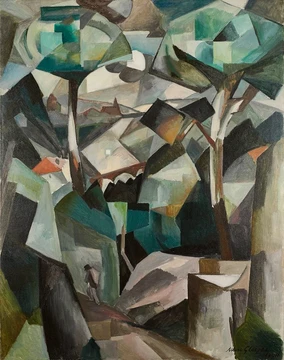
Vicente Aleixandre
Chilean poet, founder of Creationism, and avant-garde literary critic.

via Wikipedia: Vicente Huidobro · see source
Vicente García-Huidobro Fernández (January 10, 1893 – January 2, 1948), known by the pseudonym Vicente Huidobro, was a Chilean poet, writer, editor and literary critic. A proponent of the avant-garde, Huidobro was the founder of Creationism (Spanish: creacionismo) and is considered one of the four greats of Chilean poetry.
- born
- January 10, 1893
- died
- January 2, 1948
- field
- Poetry, writing, editing, literary criticism
- nationality
- Chilean
- known_for
- Founder of Creationism (creacionismo); considered one of the four greats of Chil
Verified Timeline
Lore & Background
Huidobro was born on 10 January 1893 in Santiago to Vicente García Huidobro and María Luisa Fernández, a feminist writer, editor, and poet. Through his parents Huidobro belonged to the Chilean aristocracy and was of Spanish descent. He spent his first years in Europe, and was educated by French and English governesses. Once his family was back in Chile, Vicente was enrolled at the Colegio San Ignacio, a Jesuit secondary school in Santiago, where he was expelled for wearing a ring that he claimed was a wedding ring. In 1910 he studied literature at the Instituto Pedagogico of the University of Chile, but a good part of his knowledge of literature and poetry came from his mother, poet María Luisa Fernández Bascuñán. She used to host 'tertulias' or salons in the family home, where sometimes up to 60 people came to talk and to listen to her talk about literature, with guests including members of the family and servants. Later, in 1912, she would help him financially and emotionally to publish his first magazine 'Musa Joven' (Young Muse).
Reader's Guide
In 1911 he published Ecos del alma (Echoes of the Soul), a work with modernist tones. In 1913 he published Canciones en la noche (Songs in the Night). The book included some poems previously published in 'Musa Joven' as well as his first calligram, 'Triángulo armónico' ('Harmonic Triangle'). In 1913, along with Carlos Díaz Loyola (better known as Pablo de Rokha), he published three issues of the magazine Azul (Blue), and published both Canciones en la noche and La gruta del silencio (The Grotto of Silence). The next year, he gave a lecture, Non serviam, in which he reflected on his aesthetic vision. The same year, in 'Pasando y Pasando' ('Passing and Passing'), Vicente explained his religious doubts, earning himself the reproach of both his family and the Jesuits. The same year, he published 'Las pagodas ocultas' (1916), and signed it for the first time as Vicente Huidobro. In 1916, he traveled to Buenos Aires with Teresa Wilms Montt, a young poet whom he had rescued from a convent. While in Buenos Aires, Huidobro outlined his creationism literary theory, later a literary movement, and published 'El espejo de agua' (The Mirror of Water).
Did You Know?
- Huidobro was expelled from the Jesuit Colegio San Ignacio for wearing a ring he claimed was a wedding ring.
- His mother, María Luisa Fernández, was a feminist writer, editor, and poet who hosted tertulias with up to 60 attendees, including family and servants.
- In 1923, his critique of the British Empire, Finis Britannia, earned him a postcard of support from Mahatma Gandhi.
- He was kidnapped in 1924 and disappeared for three days, later attributing the incident to two 'Irish scouts' but refusing to give more details.
- His 'Painted poems' exhibition at the Théâtre Édouard VII in Paris was shut down for being too 'disruptive'.
Aristocratic Roots and a Mother's Salon
Vicente García-Huidobro Fernández entered the world in Santiago on January 10, 1893, into a family that moved within the upper echelons of Chilean society. Both parents carried Spanish lineage, and his mother, María Luisa Fernández, was herself a poet, editor, and committed feminist. The young Vicente's earliest formative years unfolded in Europe, where French and English governesses shaped his linguistic sensibilities before the family returned to Chile. At the Jesuit-run Colegio San Ignacio in Santiago, his rebellious streak surfaced early: he was expelled for wearing a ring he insisted was a wedding band. By 1910 he had enrolled in the literature program at the Instituto Pedagógico of the University of Chile, though his true literary education came from a different source entirely. His mother hosted elaborate tertulias in the family home, gatherings that could draw as many as sixty attendees—relatives, servants, and literary friends alike—where she would speak at length about books and ideas. When the time came in 1912 to launch his first magazine, Musa Joven, it was his mother who provided both the financial backing and the emotional encouragement to see it through.
From Modernist Echoes to a New Poetic Doctrine
Huidobro's early publications trace a rapid evolution away from the decorative modernism of his generation. His 1911 debut, Ecos del alma, still carried those ornamental modernist tones, but by 1913 the trajectory had shifted decisively. That year brought Canciones en la noche, which contained his first calligram, Triángulo armónico, and the same year he co-founded the magazine Azul with Pablo de Rokha, issuing three numbers alongside the publication of La gruta del silencio. In 1914 he delivered a lecture titled Non serviam that laid out his aesthetic convictions, and in the piece Pasando y Pasando he openly aired his religious doubts, drawing censure from both his own family and the Jesuit order. The pivotal moment arrived in 1916: he published Las pagodas ocultas under the name Vicente Huidobro for the first time, and while in Buenos Aires with the poet Teresa Wilms Montt he articulated the theoretical framework that would become known as creacionismo. He also produced El espejo de agua there before moving to Europe, where a stop in Madrid reconnected him with Rafael Cansinos-Assens, a correspondent since 1914. Settling in Paris, he released Adán, marking the opening of a new artistic phase.
The Parisian Orbit and a Cosmopolitan Practice
Once established in Paris, Huidobro immersed himself in the city's avant-garde. His circle included Pablo Picasso, Juan Gris, Jacques Lipchitz, Francis Picabia, Joan Miró, Max Ernst, Paul Éluard, Amedeo Modigliani, and Blaise Cendrars. In 1917 he contributed to Pierre Reverdy's magazine Nord-Sud alongside Guillaume Apollinaire, Tristan Tzara, Jean Cocteau, André Breton, Louis Aragon, and Max Jacob, though a falling-out with Reverdy ended that collaboration. That same year he published Horizon carré, a French-language version of poems from El espejo de agua, with Juan Gris assisting on the translation. From 1918 onward he made annual trips to Madrid, where he shared creacionismo with Spain's artistic elite, met the Delaunay couple, and rekindled his friendship with Cansinos-Assens. He also launched the Ultraísmo movement, corresponded with Tzara, and collaborated on a Dadaist publication. In Paris he worked with Amédée Ozenfant and Le Corbusier at L'Esprit Nouveau and contributed to the Spanish journals Grecia, Cervantes, Tableros, and Ultra. By 1919 he had carried a rough draft of what would become Altazor to Madrid, and he took science classes while immersing himself in astrology, alchemy, and the Kabbalah.
Manifestos, Scandals, and Political Reckoning
By 1921 Huidobro had become an architect of international art discourse. He founded the magazine Creación in Madrid, showcasing work by Lipchitz, Braque, Picasso, Juan Gris, and Albert Gleizes; a second issue appeared in Paris as Création Revue d'Art. In December he delivered the lecture La Poesía, which doubled as prologue to Temblor de Cielo and Saisons Choisies. The following year he presented his theory of Pure Creation at the Branche Studio in Paris before taking it to Berlin and Stockholm. His Painted poems exhibition at the Théâtre Édouard VII was shut down for being too disruptive. In 1923 he published Finis Britannia, a critique of the British Empire that earned him the enmity of the British and a postcard of support from Mahatma Gandhi. The following year he was kidnapped and vanished for three days; later he attributed the incident to two Irish scouts but refused elaboration. He published his Manifeste peut-être in the third edition of Création alongside Tzara, René Crevel, Juan Larrea, and Erik Satie. Critic Enrique Gómez Carrillo accused Huidobro of antedating El espejo de agua and claimed credit for inventing creacionismo, forcing Huidobro to travel to Madrid to defend his priority, with Grecia rallying to his side.
Gallery
Frequently Asked Questions
Who is Vicente Aleixandre?
Vicente Aleixandre was a Spanish poet born in Seville in 1898, widely regarded as one of the towering figures of 20th-century Spanish literature. He is often grouped alongside Federico García Lorca and Juan Ramón Jiménez as a defining voice of his era.
What is Vicente Aleixandre most famous for?
He is best known for winning the 1977 Nobel Prize in Literature, awarded for poetry that explores humanity's place in the cosmos and its relationship to modern society. His work is also celebrated for revitalizing Spanish poetic traditions during the interwar period.
Which literary generation did Vicente Aleixandre belong to?
He was a core member of the Generation of '27, a circle of Spanish poets and writers who came of age around the centenary of Federico García Lorca's birth. This group reshaped Spanish letters in the 1920s and 1930s.
When and where was Vicente Aleixandre born, and when did he die?
He was born on 26 April 1898 in Seville and passed away on 14 December 1984 in Madrid. His life spanned the major upheavals of 20th-century Spain, including the Civil War and the Franco dictatorship.
Why is Vicente Aleixandre considered important in Spanish poetry?
Critics place him on par with Lorca and Juan Ramón Jiménez as one of the three greatest Spanish poets of the modern era. His Nobel citation specifically highlighted his role in renewing the traditions of Spanish poetry between the two world wars.
More in Modernist & 20Th Century Poets 1-18
Spotted an error? Know more?
This is a living reference — every entry is fact-audited, and reader corrections feed straight into our audit queue. Suggest an edit · See this site's audit record